What do I offer?
Upon your request, I will visit your property and it would be nice if you were to greet me with either a cup of coffee (black) or possibly a sweet tea, if it is summer of course.
I can come out and assess the conservation value of your property, whether or not it is suitable for native plants and wildlife with you, and we will converse on such topics. We will discuss the relative value of your property to wildlife, what species are likely frequenting your property and what you can do to improve the conservation value of your property – $200.

What does that mean?
The majority of areas that I visit across the Southern Appalachians POOR QUALITY habitat for many native species. For many reason, habitat fragmentation, development, non-native invasive species, erosion, poor farming practices.
When it comes to our forests, it is frequently because there is inadequate sunlight reaching the forest floor.
For at least the past 5000 years BP until about 1600AD, the Appalachians first people, the Cherokee stewarded these lands, the original conservationists.
I cannot put it better than a colleague, Tommy Cabe, Eastern Band of Cherokee Indians so I will not try.
“Native people did not neglect the land; we’ve worked in unison with the landscape. We’re taught not to decimate the landscape otherwise it will affect our bloodline for seven generations. That’s a long time, but that’s how we regard the land. That’s how we’ve always regarded it.”
Igleman, J. (2019) Cherokees share thousands of years of expertise in forest management. Carolina Public Press
Among other strategies, the Cherokee would set fire to all of the woods and fields, harvest native trees and plants for construction, food, medicine, as well as tools.
Following the European settlement, introduction of disease and subsequent efforts to set about extinguishing all wildland fire, now to the point where we spend billions of dollars are spent each year to protect people, mostly successful, from catastrophic wildfire.
As a result, habitat quality has declined, many wildlife have declined and continue to because the forests have dense canopy and only favor a few shade-tolerant species, most notably Great Rhododendron. This type of vegetation structure and composition is frankly poor habitat for most animals.
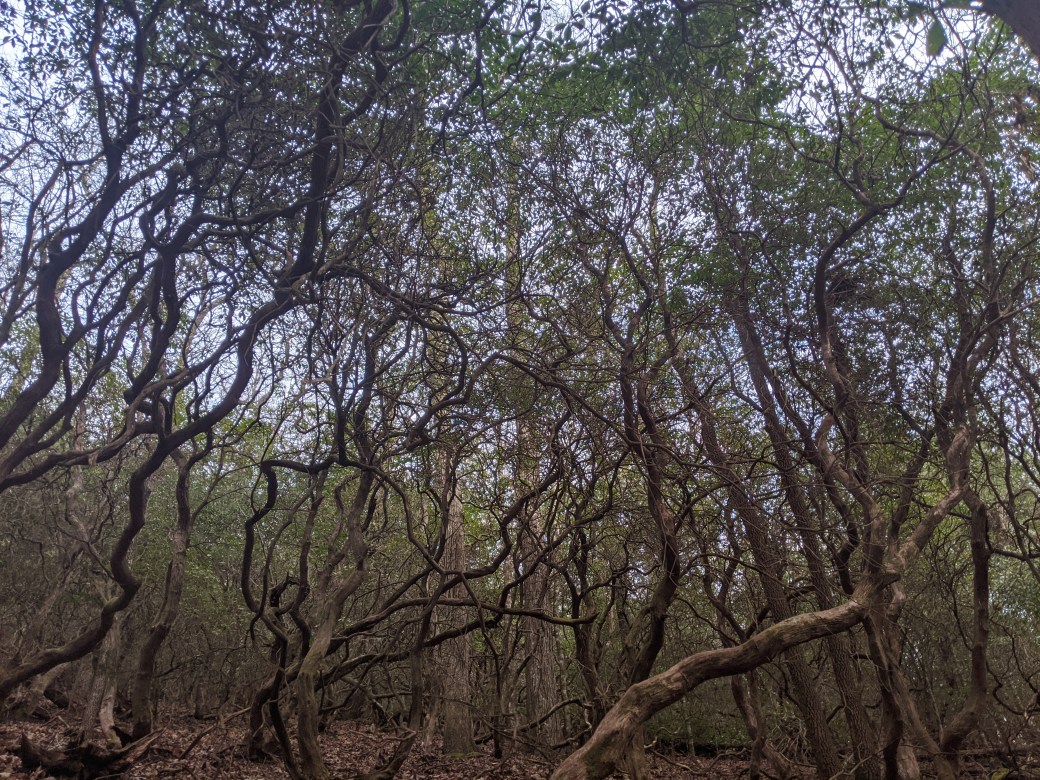
It is adequate cover for some species like bears, but it is not food for nearly all our native species. Yes, it is native and the flowers are pretty, but it was historically restricted to streamside zones and cooler wetter woods such as cove forests. What was once in many of these areas, were hundreds, if not thousands, of herbaceous plants (see Southern Appalachian biodiversity hotspot) and old growth oak-dominated woodlands, but these habitats facilitated the spread of low-intensity fire.
When we move in and attempt to control natural processes such as fire and flooding (yes that’s right, see Floodplain Biodiversity) and even insect outbreaks, to develop areas for people to farm and live, we either accept that the natural value will decline, or we can possibly mimic these process in our undeveloped or protected areas.
That is why I adhere to an ACTIVE HABITAT MANAGEMENT PHILOSOPHY and I have dedicated my life to restoring habitat using controlled burning, also known as prescribed fire.
And thus, if you do not do anything to actively manage you will almost always end up with something like this.

Whereas historically, the Southern Appalachians as well as the hills and uplands from Pennsylvania to North Carolina to Missouri were something more like:


The former is what we mostly have today. The latter is similar to what we historically had, albeit much larger, older (old growth) oaks, predominantly, but also chestnut, hickory and pine in various proportions.
Here, as if it’s not evident from the photos, I will not delve into why the latter is better for sun-loving plants, the majority of native invertebrates, especially pollinators (moths, butterflies, bees), deer, turkey, most songbirds, upland gamebirds like northern bobwhite, snakes and lizards, small mammals by providing greater food and cover resources value, but I will talk with you about that provide you with as much scientific research as you would like.
For now, you can download and print my free booklet.

IF AFTER OUR CONVERSATION, you would like to go your own way and figure things out yourself, that is fantastic!!
If you decide you want to work with me, we will discuss your goals, what means the most to you, costs, and timelines and what you can expect to happen.
EXAMPLES OF THE MOST COMMON GOALS FOLKS HAVE ASKED FOR
- I want to see more wildlife.
- I want to improve songbird diversity and develop management units for using controlled burning.
- I want to harvest more deer, turkey, rabbits or grouse and I want to cut some trees to provide income and I’d like to have some hiking trails.
- I have this really interesting wetland on my property and I want to know if it is a bog and how I should protect it.
- I am concerned about pollinator decline and want to do what I can to help butterflies and bees exist for future generations, but I also want to have low impact mountain biking trails as well.
- I want to protect salamander populations, create bat habitat, and set up a frisbee golf course.
- I want to get rid of all my English ivy, kudzu, to restore my native plants, but keep horses.
Once we have agreed on your goals, I will develop you a management proposal that will detail how we will work together to achieve our goal and how long it will take.
- Habitat Mapping
- Has timber been harvested from your property and been replanted with plantation pines?
- Do you have pasture that you’d like to let it go back to native
- Trails, rivers and creeks,
- I can obtain GIS data to determine what your property looked like before European settlement and we can work on how to restore habitat.
- Timber harvest
- Closed canopy forest with dense rhododendron shrubs that is both a wildfire hazard and wildlife desert?
- Controlled burning
- Worldwide, fire suppression has contributed more to the decline of biodiversity than anything else.

- Fire should not be feared. More of our forests and fields need to burn, not like California wildfires, but low intensity fire is critical to sustaining species.
- If you are gonna burn, you need a plan and someone experienced to do it or show you how.
- I can assemble a staff that will conduct a controlled burn for your property.
- Worldwide, fire suppression has contributed more to the decline of biodiversity than anything else.
- Non-native plant removal
- I can identify which plants you have on your property
- Wildlife surveys
- Prescribed Herbivory
- Goats are amazing animals and are extremely valuable in helping manage vegetation. Specifically, they can be used to target non-native invasive plants.
I have a sound knowledge of how you can take advantage of state and federal programs to help defray, if not completely pay for, the cost of improvements.
I look forward to working with you.
Adam Warwick
 Warwick Woodland conservation